Personal AI OS
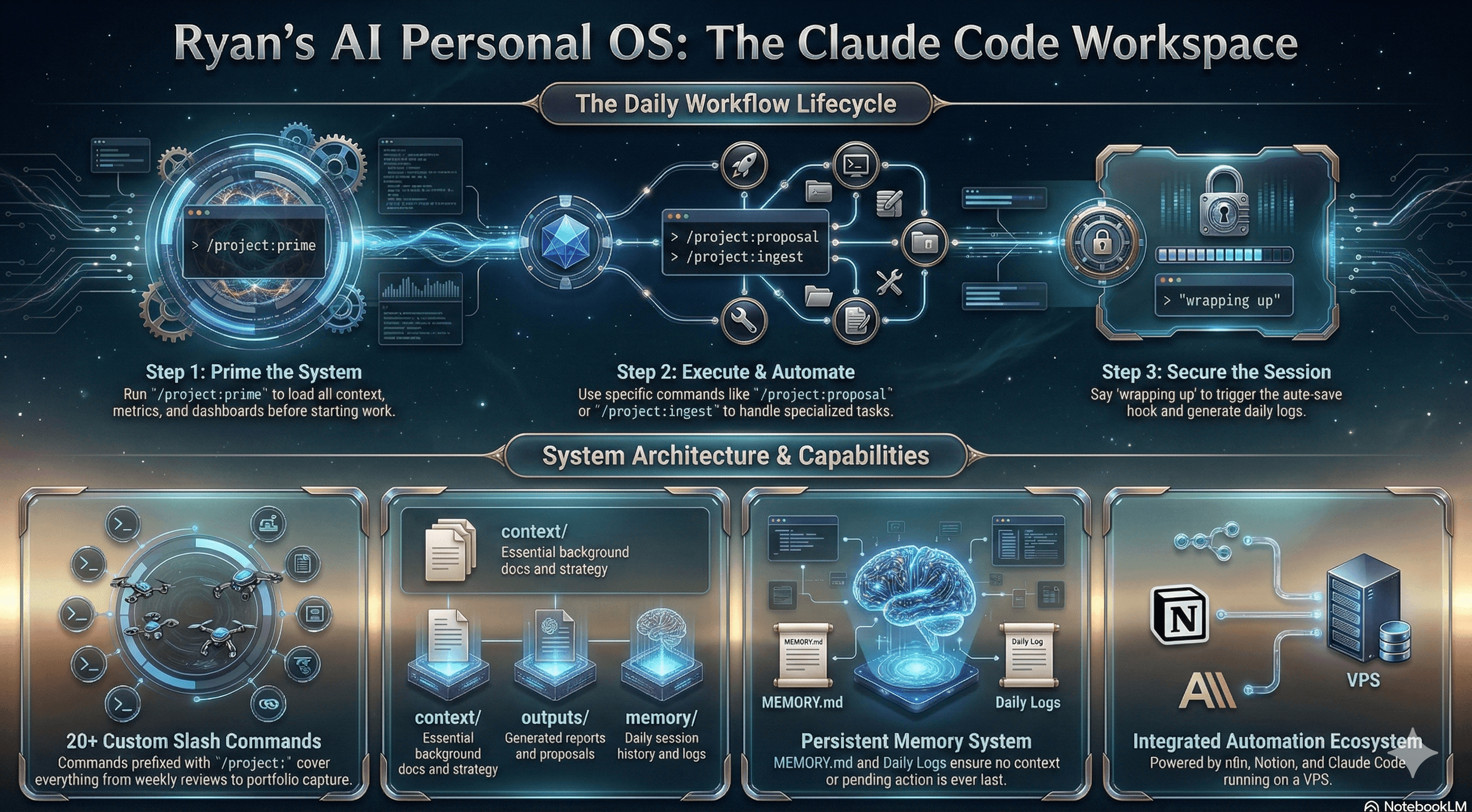
A Claude Code workspace architected as a full personal operating system. Features 20+ custom slash commands, PreToolUse safety guardrails that block dangerous operations, a Stop hook that auto-generates daily session logs, specialized subagents (researcher with read-only tools, content-writer with write tools), modular rules that auto-load from .claude/rules/, runtime configuration via YAML args, and persistent memory across sessions. Integrates with n8n for automation, Notion for task management, and Neon Postgres for structured data. Demonstrates advanced AI engineering: prompt architecture, tool orchestration, safety-by-design patterns, and building reliable systems on top of LLM capabilities.
My Thoughts
Why I Built This
I run my entire work life through Claude Code. After building and rebuilding my workspace across multiple projects, I extracted the best patterns into a reusable template that gives Claude full context from the first message.
Architecture
The workspace is structured around layered context files (business, personal, strategy, current data) that load in order via a /prime command. Safety hooks written in Python intercept dangerous tool calls before they execute. A Stop hook auto-appends session summaries to daily log files, creating a persistent memory layer across conversations.
Key Engineering Decisions
- PreToolUse guardrails catch dangerous Bash commands (rm -rf, force push, etc.) before they execute, not after. Safety is structural, not behavioral.
- Subagent architecture routes research tasks to a read-only Sonnet agent and writing tasks to a write-enabled agent, keeping the main context window clean.
- Modular rules in .claude/rules/ auto-load without editing CLAUDE.md, making the system extensible without touching core config.
- Open-sourced as a template so other developers can fork and customize for their own workflows.